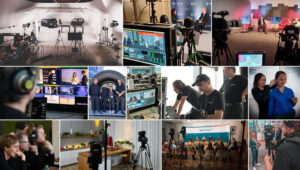
Martin attended IBC 2026 in Amsterdam. The international broadcast and media industry gathered there once again. Now he’s sharing his highlights and discussing which trends and brands in livestreaming deserve special attention.

Do we really need another technological revolution every year? After my visit to IBC, I’d say: not really. Of course, there were new cameras, encoders, software solutions, and plenty of AI. But my personal impression was that the most exciting development is that professional livestreaming technology is becoming increasingly compact, reliable, and affordable. That’s why I took a closer look at a few manufacturers and solutions in Amsterdam.
Telycam: Compact PTZ
To me, Telycam is definitely one of the manufacturers you should keep an eye on right now. Their new PTZ cameras feature fast brushless motors, powerful autofocus, and deliver 4K even via SDI. The new generation thus offers significantly more technology for the same price.
I found the Telycam Mix One particularly exciting. It combines a video mixer and PTZ control in a single device. Control cameras, switch sources, and produce the stream—all through one compact system. The concept was also well-received at the trade show: The Mix One won a Best of Show Award at IBC 2026.
For small teams, this is exactly the right approach: fewer devices, less cabling, yet still professional capabilities.
MiNEMedia: Bonding for Mobile Productions
We at Stream1 have been working with MiNEMedia for several years now. I visited Shenzhen myself to see their production and development facilities. We also regularly use their technology in our own productions.
MiNEMedia’s strength lies in bonding technology. Multiple cellular connections are bundled together to ensure a stable connection for the livestream, even on the go. Among the new products is the MiNEMedia A4 streaming camera. It is smaller than the A5, making it particularly well-suited for mobile use—such as from a car or a bicycle.
This shows the direction in which livestreaming is heading: Professional productions no longer require extensive broadcasting equipment, and new applications are constantly emerging.
Kiloview: NDI Is Growing Up
Kiloview also remains an exciting manufacturer in my view—especially when it comes to NDI, encoding, decoding, and mobile broadcasts. Here at Stream1, we’re already very familiar with the P3 Bonding Encoder. But at IBC, it became clear that Kiloview is now thinking far beyond individual encoders and building complete IP-based production workflows.
One example is the new AVX24-4 Media HUB. It allows for the centralized management and routing of NDI signals. Connections, ports, and media information are clearly displayed. In addition, a preview of NDI 6.4 was presented at IBC, showcasing new capabilities for recording, routing, and buffering. The key point, even with IP video, is that it is becoming more powerful and easier to use.
KUPO: Sometimes it just has to be sturdy
KUPO offers reliable grip and tripod equipment at attractive prices. Pascal from Vision2See now carries the brand, and I think anyone looking for new tripods should definitely check them out. Because no matter how digital production becomes—if the camera shakes, even the best AI won’t help.
Univiso: A Company to Watch
Univiso is currently even less well-known in Europe. Unfairly so, in my opinion. The Spark series is particularly exciting. In addition to mobile bonding routers, the line now also includes bonding encoders—and at prices that are truly attractive for smaller productions. It remains to be seen whether Univiso will gain a foothold in the European market. But it’s precisely manufacturers like this that make the IBC interesting: Today, hardly anyone knows them; tomorrow, they could be the talk of the town.
Remote Production Is Becoming the Norm
In addition to individual products, a major trend was clearly evident at IBC: production and the production location are becoming increasingly decoupled. IBC itself set an example of this. Remote-controlled PTZ cameras were used at several locations throughout the trade show. The footage from Amsterdam was then processed by a remote team in Prague. This reduces the need for on-site personnel and infrastructure and demonstrates just how flexible modern production workflows have become.
5G is expected to be not only fast but also reliable
Developments are also continuing in the field of mobile communications. Bonding across multiple connections has long been part of our routine. The next step is to make the connection more predictable. At IBC, tests were conducted—among other things—to determine how network APIs can be used to specifically reserve quality and priority for broadcast applications.
One test was even conducted during a DFB Cup game with about 45,000 spectators—a situation where mobile networks are under particularly heavy strain. This is crucial for live streaming: In the future, a mobile connection should not only be fast but also remain stable even when many people are online at the same time.
AI Is Becoming Practical in Live Operations
Of course, AI was a hot topic everywhere at IBC. What I find particularly interesting are applications that help with day-to-day production tasks. These include automatic transcription, subtitles, and live translations. Different language versions and subtitles can be integrated directly into a live stream using these tools.
My conclusion: Not revolutionary—but better
For me, IBC 2026 demonstrated one thing above all else: livestreaming isn’t being completely reinvented right now. But it is improving in many areas. Cameras are getting faster, bonding systems are becoming more compact, IP workflows are becoming more streamlined, and it’s possible to run entire productions with less and less hardware. At the same time, smaller manufacturers are catching up tremendously. Professional livestreaming is no longer a niche topic, nor does it automatically require a huge budget.
And if you want to know which technology really makes sense for your own production, please get in touch with us. Email us at hello@stream1.eu or call us at 089 41 41 453 10. We don’t just check out new technology at trade shows—we actually use it ourselves and rely on it every day.