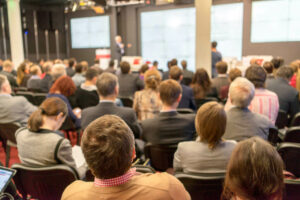
Imagine you’re giving a talk at a trade fair. You step off the stage, grab a coffee, have a few chats and check your email inbox that evening. There, waiting for you, is your talk, already edited. No days of post-production, no labourious editing processes and no large camera crew working behind the scenes all day long.
Sounds like a pipe dream? Not quite. The technology behind it is already taking shape. Semi-automated AI video production at trade fairs could fundamentally change the way we record presentations, panel discussions and conferences. And because, as you know, we at Stream1 aren’t particularly good at simply watching exciting technology from afar, we’re working on a solution of our own.
When AI suddenly takes the reins
Anyone who has ever provided audiovisual support for a trade fair lasting several days with multiple presentation stages will be familiar with the challenge: on one stage, a discussion is taking place on artificial intelligence; on the next, a company is presenting its latest innovation; and three halls away, the next panel discussion is already getting underway.
Everything needs to be recorded. As professionally as possible. Ideally, it should be available straight away. Traditionally, this requires camera crews, a production control room and, afterwards, someone to review, edit and export the footage. With several stages running simultaneously, staffing costs and production costs can quickly mount up. But what if a large part of this work could be done automatically?
This is exactly where AI-powered video production comes in. Smart cameras track the speakers, software detects when the speaker changes, and automated editing systems decide which angle is the right one at any given moment. The technology takes care of the routine tasks. People remain in control.
Miru Suite shows what is already possible today
One company at the forefront of this development is MiruSuite. With solutions for automated camera tracking and AI-powered live editing, MiruSuite is one of the pioneers in automated video production. Just how well this is already working was demonstrated, amongst other things, at two events in 2026.
The exciting thing about it is that it’s not simply a matter of pointing a camera at a stage and hoping for the best. It’s about professional video production, where the software handles many of the repetitive tasks automatically. Incidentally, here at Stream1, we’re not just familiar with MiruSuite from specialist articles. We’ve already collaborated with the company and are exploring the possibilities of such systems in depth.
Stream1 continues to develop: from the presentation straight to your inbox
For us, however, automated camera control is just the beginning. After all, what use is it to a trade fair organiser if, although the recording happens automatically, the videos still end up spending days in post-production? Our vision therefore goes a decisive step further.
At Stream1, we’re currently working on a workflow that combines semi-automated AI production at trade fairs with the rapid, largely automated delivery of the finished videos.
Here’s what that might look like in future:
- The presentation begins. Several cameras film the stage. The AI assists with tracking and selects suitable frames.
- The editing takes place in real time. Changes in speakers, presentations and camera angles are processed automatically during the presentation.
- The recording is saved. The edited video footage is backed up immediately and assigned to the relevant presentation.
- Delivery is automated. Once completed – and following a brief quality check where necessary – the video is exported and prepared for dispatch.
- The client receives their video. Ideally, the finished presentation will be in their email inbox or available via a download link on the very same day of the trade fair.
No long waiting times. No unnecessary intermediate steps. And above all: significantly less manual effort. This is precisely the combination of intelligent live production, automated editing and rapid delivery that we are currently working on. It is not yet a finished standard product from Stream1, but a development in which we see enormous potential.
Fewer staff, lower costs – but no compromise on quality
Now comes the question that is likely to be of particular interest to organisers and exhibitors: what are the financial benefits of all this? Quite a lot, if the conditions are right. With traditional trade fair productions, it is often necessary to manage several stages simultaneously. Every additional stage means additional technical equipment, additional production work and, often, additional staff.
With semi-automated video production, a small team could in future monitor several stages from a central location. Cameras automatically track the speakers, standard cuts are carried out with the aid of software, and the recordings run in the background. This can significantly reduce staffing requirements and, as a result, lower production costs.
This is particularly interesting for event organisers who, until now, have only been able to record individual talks for cost reasons. Automated workflows could make it cost-effective to professionally record significantly more programme items. Of course, AI does not replace every task. Technical set-up, sound control, quality assurance and dealing with unforeseen situations remain important. And if five people suddenly start discussing something on stage at the same time, the presentation breaks down and someone spontaneously walks through the audience, an experienced technician is still rather handy.
The future therefore does not necessarily lie in a control room devoid of people, but in intelligent collaboration between humans and machines.
A day at a trade fair. Dozens of talks. Loads of ready-made content.
The real benefit of automated video production goes even beyond the cost savings. This is because an incredible amount of valuable content is generated at trade fairs, much of which has often gone unused until now. Engaging specialist talks, interviews with experts, product presentations and panel discussions often disappear into some archive after the event – if a recording exists at all.
With an automated production workflow, this content could be repurposed much more quickly. A presentation given in the morning could be embedded on the company’s website by that same evening. A panel discussion could be sent out to all participants promptly. And selected presentations could later be turned into additional social media clips. A one-off event thus becomes a source of content that continues to have an impact long after the exhibition day is over.
For organisers, this means greater visibility. For exhibitors, it means greater reach. And for speakers, it offers the opportunity to share their content directly with their community.
Why we at Stream1 rely on semi-automated AI production
We love professional video production. We love great camera work, crisp sound and perfectly timed cuts. What do we love less? Hours of routine tasks that intelligent software could handle just as well. That’s why we’re focusing intensively on how we can combine our existing production systems with new automation capabilities.
As a live-streaming service provider with extensive experience at Messe München and at events throughout Germany, we know what really matters in practice. A solution must not only work in a perfectly prepared test environment, but also amidst spontaneous programme changes, changing speakers and the usual hustle and bustle of a trade fair. Our aim is to develop a scalable and cost-effective workflow for the automated recording of trade fair presentations.
In doing so, we aim to combine tried-and-tested video technology with intelligent software solutions. Not because ‘AI’ has to be plastered everywhere these days, but because it can deliver genuine added value here.
Conclusion: The future of trade fair video production is already here
The examples from MiruSuite impressively demonstrate just how far automated video production has come. Intelligent camera tracking and automatic live editing are no longer merely visions of the future. The next big step is to integrate these technologies into a seamless production process: from filming through to editing and on to the final delivery.
That is exactly what we are working on at Stream1.
Our vision? A trade fair where high-quality presentation videos are produced without the need for a full video crew on every stage. And an organiser who, at the end of the day, doesn’t have to wait for their recordings but can start using them straight away. AI does the editing. We make sure the result is just right. And until our own solution is ready, we’ll keep tinkering away. After all, here at Stream1, we’ve always preferred to press ‘Record’ rather than wait for the future.
Are you planning a trade fair, a conference or an event with multiple presentation stages? Then get in touch with us to discuss the possibilities for efficient video production. We’d be happy to advise you on existing solutions and show you the latest developments in automated trade fair recording.