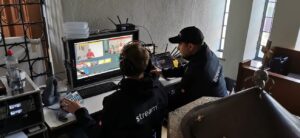
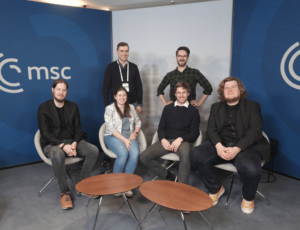
A lot of technology, limited space, and very little time: A livestream production at the Munich Security Conference is no ordinary job. While top international politicians, journalists, and experts discuss global politics at the Bayerischer Hof, every move behind the scenes has to be just right.
Stream1 has been supporting the Munich Security Conference for five years now as a production partner of LOBECO. This involves setting up two parallel studios under strict security conditions—with tight schedules, varying formats, and high-profile guests.
You are currently viewing a placeholder content from YouTube. To access the actual content, click the button below. Please note that doing so will share data with third-party providers.
More InformationLive Streaming in a High-Security Zone
During the Munich Security Conference, the Bayerischer Hof becomes a high-security zone. Only accredited individuals are granted access; technical equipment must be registered and inspected; and even the routes through the hotel are, in some cases, strictly designated. It’s virtually impossible to spontaneously deliver a forgotten cable or bring additional equipment into the building. That’s why technical planning begins long before the first interview. Cameras, microphones, lighting, production equipment, and backup devices must be prepared, tested, and fully in place on site. The more precise the planning, the more calmly the team can work during the live production.
Five years of experience—and still no sense of routine
Since 2022, Stream1 has been handling production tasks at the Munich Security Conference. The experience gained over several years helps the team realistically assess venues, security procedures, and organizational specifics. Nevertheless, no two assignments are alike. Guests arrive earlier or later than planned, interviews get rescheduled, and formats change at the last minute. Experience doesn’t prevent such surprises. However, it ensures that the team can respond to them flexibly and calmly.
Two studios operating in parallel
One of the biggest challenges is running two fully equipped studios at the same time. While a live interview is being broadcast in one room, the next guest is already being prepared in the other.
A team of about ten people is working on this. Their responsibilities include, among other things:
- Studio Management and Coordination
- Cinematography and Camerawork
- Sound and Microphone Placement
- Lighting and Technical Support
- Guest Coordination
- Delivery of signals to platforms and editorial teams
Extensive coordination is virtually impossible during production. That is why responsibilities must be clearly assigned in advance. Everyone on the team must know who makes decisions and who takes action in the event of technical or organizational changes.
“We’re going live in five minutes.”
This sentence captures the day-to-day reality of the Munich Security Conference particularly well:
“We’re here now and will go live in five minutes.”
Guests often arrive straight from interviews, panel discussions, or political events. There’s no time for lengthy rehearsals. Greetings, microphone setup, seating arrangements, lighting checks, and sound checks must all be completed within a few minutes. At the same time, the requirements vary from guest to guest. Height, clothing, glasses, sitting posture, and pitch all affect the video and audio quality.
The studio must therefore be designed to be flexible enough to allow for quick adjustments. Professional livestreaming technology adapts to people—not the other way around.
Different Formats on a Tight Schedule
During the conference, we produce one-on-one interviews, roundtable discussions, podcasts, panel discussions, and social media content. Some formats are broadcast live, while others are recorded and then delivered to newsrooms or platforms. In addition, there are international guests and multiple languages. Camera angles, microphones, seating arrangements, and signal paths must therefore be adjusted regularly. There is no single setup that works unchanged for several days. A technical infrastructure that allows for quick changes is essential.
A lot of technology in a small space
When people think of large-scale productions, they often picture spacious studios and control rooms. At the Bayerischer Hof, however, space is limited. Nevertheless, cameras, lighting, sound equipment, control rooms, monitors, and various signal paths are required. At the same time, emergency exits and safety zones must not be obstructed.
The key question, therefore, is not: How much technology can we bring with us?
Instead: What technology do we really need?
Compact systems, preconfigured devices, and clearly labeled signal paths save space and setup time. On the other hand, every unnecessary device increases the effort required and creates additional sources of error.
Backup Systems for Emergencies
In a professional livestream production, key signal paths must be safeguarded. Backup equipment is on hand, and critical components are tested in advance. The team must also know how to respond to a problem without unnecessarily disrupting the ongoing broadcast. Ideally, viewers won’t even notice anything is wrong. That is precisely the goal of a good backup strategy: technical difficulties should not automatically lead to a visible interruption.
Teamwork as a Decisive Factor
A single person cannot manage two studios running in parallel. The camera, sound, production, lighting, and guest support teams must work closely together. During the broadcast, there are often only a few seconds left for coordination. Many decisions must therefore be made before production begins. Professional livestreaming isn’t just a matter of the technology used. Just as important is a well-coordinated team that can rely on one another and maintain a clear overview even under time pressure.
What Companies Can Learn From This
The Munich Security Conference is an extraordinary event setting. However, many of the requirements also apply to other corporate events.
Whether it’s an international conference, a press conference, a town hall meeting, or a management meeting: The technology must be set up, responsibilities must be clearly defined, and critical communication channels must be secured.
Not every company needs two studios in a high-security hotel. However, every professional live production benefits from good planning and a team that solves problems before they become visible to the audience.
Live-stream production comes with responsibility
With a video recording, a scene can be replayed. With a livestream, it cannot.
As soon as the broadcast begins, the video, audio, and transmission must all be working properly. Especially when high-profile guests are involved or politically sensitive topics are being discussed, there is no room for lengthy interruptions or impromptu experiments.
The production at the Munich Security Conference therefore illustrates particularly clearly what matters most: experience, meticulous preparation, flexible technology, and a well-coordinated team. From the outside, the result appears, at best, quite simple: the guests take their seats, the discussion begins, and the audience can follow along live. The fact that behind this calm scene, two studios, numerous signal paths, and many focused people are hard at work is something you’re not supposed to see at all.
Are you planning a complex livestream production?
Stream1 handles the technical planning and execution of conferences, press conferences, town hall meetings, and hybrid events.
From camera, sound, and lighting to directing and reliable transmission, we develop a setup that suits your spaces, content, and target audiences.
Talk to us about your next event—preferably not just five minutes before it goes live.