The figures are merciless: a horizontal 16:9 live stream on Instagram or TikTok only uses a fraction of the valuable screen space of mobile devices. What remains are large, black bars and a disappointing user experience.
The future of mobile content is unmistakably vertical. But this change is more than just a technical trick: it requires a fundamental rethink. New workflows, adapted technology and a completely different visual language are the key.
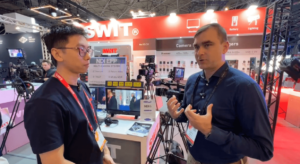
How does this transformation succeed in practice? Michael Bamberger provides the answers to these questions. In an interview with the technology expert from Stream1, we analyze the key findings from the Hollyland workshop. The leading manufacturer of professional radio links, video transmission systems, and creator equipment was our strong partner for the workshop.
The most powerful moment of the workshop
“The workshop had the subtitle: How vertical video production is shaping the livestream and content industry. What was the most powerful moment that showed exactly that?”
It was the realization that vertical video productions are no longer the exception. They are increasingly in demand, even in professional live streaming. This means that workflows have to be completely rethought. Your own technology fleet needs to be put to the test. And above all, tests must be carried out with target platforms such as TikTok in order to understand what really works there.
Over the last few months, we have gathered a lot of experience, put together packages and advised customers on whether the vertical format really makes sense for their purposes. Because not all content works vertically. But when it does, it does it right. Social media demands it, users expect it. Anyone who still thinks in the classic landscape format today will lose reach. That was the moment when everyone realized: This is no longer a trend, this is the new reality.
The technical setup: Three cameras, two radio links, one target
“You showed a technical setup and your workflow. What exactly did you set up?”
Hollyland had suggested holding joint workshops. Die Zielgruppe waren Studierende und alle, die sich für moderne Videoproduktion interessieren. The content creation equipment we demonstrated and tested was specifically designed for mobile and vertical setups.
On the one hand, there was the Lark Max 2 audio radio link, which ensures that the sound arrives in sync with the camera. Anyone who has ever tried to stream several cameras simultaneously and keep the sound under control knows how important this is. Then there’s the Cosmo C2 video radio link, a wireless video kit that transmits image signals wirelessly. And finally, three VenusLiv V2 cameras that have been specially developed for the portrait format.
The biggest advantage of these cameras is that they are ready for immediate use. The setup is portable and operation is simple. They also have good autofocus and high light intensity, which is particularly important for fast social media productions. For a TikTok studio setup, these are exactly the features that make the difference.

The workflow: From the start to the finished 9:16 livestream
“Can you explain the workflow? From the start to the finished livestream in 9:16 format?”
The workflow that we showed in the workshop was deliberately kept pragmatic. The focus is on vMix, an image mixing software that also supports vertical formats. If you search for a vMix tutorial in German, you can now find a number of instructions, but practice often looks different from theory.
One of the three cameras is combined with the audio wireless link to ensure synchronized sound. Another camera is transmitted wirelessly and two are connected via classic HDMI connections. Not everything has to be wireless, but where it makes sense, you save on cables and gain flexibility.
As soon as the cameras are integrated into vMix, the RTMP data of the target platform is entered. RTMP is a transmission protocol that ensures that the stream arrives at TikTok, Instagram or YouTube. The stream can then start. The image is played out directly in portrait format without having to be cropped or scaled afterwards – exactly how social media videos should look in the end.
The ergonomic challenge: when the camera doesn’t play along
“What is the biggest difference between a 16:9 and a 9:16 production?”

This is where it gets interesting, because it’s not just about technology. The biggest challenge is actually ergonomic. Cameras have been designed for landscape format for decades. The buttons are located where they are easy to reach when held horizontally. The holding position feels familiar. If you now turn the camera to vertical format, everything becomes unfamiliar.
The controls are suddenly in places that are difficult to reach when holding the camera. The balance of the camera shifts. You have to rethink, regrip, work differently. This is no small thing, but a real change for teams that have been producing in landscape format for years.
But the format is booming. Today, social media is primarily vertical. The use of smartphones has completely changed our viewing behavior. Nobody turns their cell phone to watch a video anymore. The platforms have adapted, and now we producers have to do the same. The question is no longer whether you produce vertically, but how well you do it.
What remains in the end: A rethink of the entire production chain
The workshop impressively demonstrated that vertical video production is more than just a technical detail. It is a shift in the way we think and produce content. It’s no longer just about the perfect image section in the classic aspect ratio. It’s about designing content in such a way that it reaches where the target group is. And today that’s on TikTok, Instagram and YouTube Shorts.
The technology is there. The tools work. What is often missing is the courage to leave the beaten track and try out new workflows. That’s exactly what workshops like this one are for: to show that it works, to break down fears and to present practical solutions.
The next time you plan a livestream, ask yourself a simple question: Where will it be viewed? Desktop monitor or smartphone? The answer will tell you which format you need.
Start your transformation to a vertical format now – together with us. Discover tailor-made solutions for your next project at www.stream1.eu.